|
Implementation Guidelines for the Open Archives Initiative Protocol for Metadata Harvesting
- Specification for an OAI Static Repository and an OAI Static Repository Gateway
|
Protocol Version 2.0 of 2002-06-14
Document Version 2002/11/11T00:40:00Z
http://www.openarchives.org/OAI/2.0/guidelines-static-repository.htm
alpha release. do not distribute.
|
Editors
The OAI Executive:
Herbert Van de Sompel <herbertv@lanl.gov>
-- Los Alamos National Laboratory - Research
Library
Carl Lagoze <lagoze@cs.cornell.edu>
-- Cornell University - Computing and Information
Science
From the OAI Technical Committee:
Michael Nelson <mln@cs.odu.edu>
-- Old Dominion University - Dept of Computer Science
Simeon Warner <simeon@cs.cornell.edu>
-- Cornell University - Computing and Information
Science
Contributors:
Patrick Hochstenbach <hochsten@lanl.gov>
-- Los Alamos National Laboratory - Research
Library
Henry Jerez <hjerez@lanl.gov>
-- Los Alamos National Laboratory - Research
Library
This document is one part of the
Implementation Guidelines that accompany the
Open Archives Initiative Protocol for Metadata Harvesting (OAI-PMH).
1. Introduction
For an adequate comprehension of this specification, a prior understanding
of the OAI-PMH
is required.
The specification of a Static Repository, introduced here, provides a simple
approach for exposing relatively static and small collections of metadata records
through the OAI-PMH. The Static Repository approach is targeted at data
providers that:
- Have metadata collections ranging in size between 1 and 5000 records;
- Are not in a position to host OAI-PMH-compliant repository software;
- Have access to the data-hosting services of a standard Web server, which
- in normal circumstances - is permanently network-accessible.
The Static Repository is an XML file that is made accessible by a data
provider at a persistent network-location. The XML file has a well-defined
structure and it contains information similar to that in OAI-PMH responses.
This includes metadata records and supporting information required for the purpose
of harvesting via the OAI-PMH.
A Static Repository becomes harvestable via the OAI-PMH through the intermediation
of a Static Repository Gateway. The properties of a Static Repository Gateway
are also described in this specification. A Static Repository Gateway can make
one or more Static Repositories harvestable. Due to the fact that a Static Repository
Gateway assigns a unique base
URL to each such Static Repository, harvesters can harvest Static Repository
information in exactly the same manner as they harvest any other OAI-PMH
Repository.
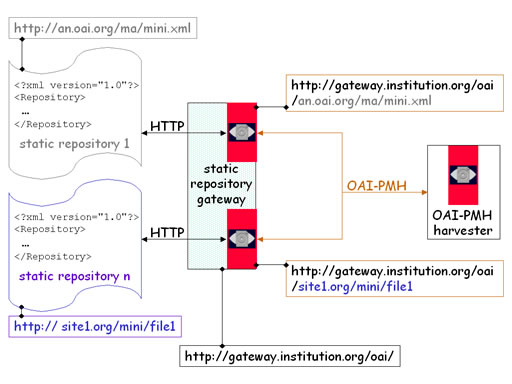
Both the Static Repository and the Static Repository Gateway are described
in the remainder of this document. They are further clarified through the accompanying
figure.
|
|
|
Static Repositories, a Static Repository Gateway and
an OAI-PMH Harvester
|
2. Concepts and definitions
Some concepts that are essential for an understanding of this specification
are given, below.
Static Repository: A Static Repository is an XML file that is valid
according to the XML Schema provided in Section 3.2. A Static Repository contains
metadata records and supporting information required for the purpose of harvesting
via the OAI-PMH. A Static Repository is managed by a data
provider at a persistent network-location of its choice. A Static Repository
is not a OAI-PMH
Repository, because it is a file, not a server that can respond to the six
OAI-PMH
requests.
Static Repository network-location: The network-location
of a Static Repository is the HTTP address where the Static Repository is accessible.
Static Repository Gateway: A Static Repository Gateway makes one or
more Static Repositories harvestable via the OAI-PMH. It assigns each such Static
Repository a unique base
URL and thereby exposes each individual Static Repository as an individual
OAI-PMH
Repository. A Static Repository Gateway complies with restrictions and conventions
described in Section 4.
3. Static Repository Description
3.1 Static Repository restrictions and conventions
Static Repositories are meant for small and relatively static metadata collections.
All metadata, identifiers, and datestamps are managed in a single XML file.
This file may be created manually with an XML editing tool, or a text processing
application. Alternatively, a Static Repository might be generated periodically
by a script that extracts information from an existing database.
The following restriction and conventions apply to a Static Repository:
- At the level of the Repository:
- A Static Repository does not support the OAI-PMH notion of
sets.
- A Static Repository does not support the OAI-PMH notion of
deleted
        records
.
- The only supported harvesting
granularity is YYYY-MM-DD.
- The content of the "baseURL" element - the child of the "Identify"
element in the XML Static Repository - must be the Static
Repository network-location.
- A Static Repository must not have a
resumptionToken
element as a child of the ListRecords element in the XML Static Repository.
- At the level of records:
- The "datestamp" of records must be of the ISO8601 form
YYYY-MM-DD.
- At the level of the Static Repository network-location:
- The Static Repository network-location must
be an HTTP address of the form
http://host:port/path/file
. The HTTP address must not contain a fragment or a querystring.
- The MIME type of a Static Repository must be text/xml
3.2 Static Repository format
The structure of the Static Repository is defined by means of the XML Schema
shown below. Static Repositories must validate against this XML Schema.
Static Repository XML Schema
|
<?xml version="1.0" encoding="UTF-8"?>
<xs:schema targetNamespace="http://www.openarchives.org/OAI/2.0/static-repository"
           xmlns:oai="http://www.openarchives.org/OAI/2.0/"
           xmlns:sr="http://www.openarchives.org/OAI/2.0/static-repository"
           xmlns:xs="http://www.w3.org/2001/XMLSchema"
           elementFormDefault="qualified"
           attributeFormDefault="unqualified">
  <xs:import namespace="http://www.openarchives.org/OAI/2.0/"
             schemaLocation="http://www.openarchives.org/OAI/2.0/OAI-PMH.xsd"/>
  <xs:annotation>
    <xs:documentation>This XML Schema specifies the structure of a so-called OAI-PMH Static Repository.
     A Static Repository is an XML file that is valid according to this XML Schema.
     A Static Repository is made accessible as an XML file on a standard web-server.
     No special software is required at the end of the organization that makes the Static Repository
     available.
     A Static Repository becomes harvestable via the OAI-PMH through the intermedation of a
     Static Repository Gateway.
     The following important restrictions apply to a Static Repository:
     (1) A Static Repository does not support OAI-PMH "sets".
     (2) A Static Repository does not support the OAI-PMH notion of "deleted records".
     (3) The only supported harvesting granularity is YYYY-MM-DD.
     (4) The content of the "baseURL" element - child of the "Identify"
         element in the XML Static Repository - must be the Static Repository network-location.
     (5) A Static Repository must not have a resumptionToken element as a child of the ListRecords
         element in the XML Static Repository.
     (6) the "datestamp" element of records must be of the form YYYY-MM-DD.</xs:documentation>
  </xs:annotation>
  <xs:annotation>
    <xs:documentation>This Static Repository XML Schema by Herbert Van de Sompel and Henry N. Jerez.
      Los Alamos National Laboratory, Research Library, Digital Library Research and Prototyping Team.
      October 26th 2002.  Inspired by the Vida work by Steven Bird for OAI-PMH v.1.0 and
      for the Open Languages Archives Community;
      see  http://www.language-archives.org/docs/implement.html#Vida
    </xs:documentation>
  </xs:annotation>
  <xs:element name="Repository" type="sr:repo"/>
  <xs:complexType name="repo">
    <xs:annotation>
      <xs:documentation>The Repository element has 2 child elements -- "Identify" and
      "ListMetadataFormats" -- that are directly derived from the XML Schema defining responses
      to OAI-PMH v.2.0 requests.
      The third repeatable element -- "ListRecords" -- is an extension of the ListRecords
      defined in the XML Schema defining responses to OAI-PMH v.2.0 requests; it has an additional
      attribute indicating the metadataPrefix of the included metadata records.</xs:documentation>
    </xs:annotation>
    <xs:sequence>
      <xs:element name="Identify" type="oai:IdentifyType"/>
      <xs:element name="ListMetadataFormats" type="oai:ListMetadataFormatsType"/>
      <xs:element name="ListRecords" type="sr:ListRecordsType" minOccurs="1" maxOccurs="unbounded"/>
    </xs:sequence>
  </xs:complexType>
  <xs:complexType name="ListRecordsType">
   <xs:complexContent>
     <xs:annotation>
      <xs:documentation>The ListRecords element contains all records with metadata expressed to one
      of the metadata formats supported by the Static Repository.  The "metadataPrefix" attribute
      specifies the metadataPrefix of the included metadata; it must correspond with a value
      of the metadataPrefix element contained in the ListMetadataFormats element</xs:documentation>
     </xs:annotation>
    <xs:extension base="oai:ListRecordsType">
       <xs:attribute name="metadataPrefix" type="oai:metadataPrefixType" use="required"/>
    </xs:extension>
   </xs:complexContent>
  </xs:complexType>
</xs:schema>
|
| This Schema is available at http://www.openarchives.org/OAI/2.0/static-repository.xsd |
3.3 Making a Static Repository harvestable through a Static Repository Gateway
A Static Repository must use the intermediation of a single Static Repository
Gateway to make its metadata harvestable. In order to make the existence of a
Static Repository known to a chosen Static Repository Gateway, the administrator
of the Static Repository must issue an OAI-PMH Identify
request to the base
URL at which the chosen Static Repository Gateway will make the Static Gateway
harvestable. This action automatically establishes the relationship between the
chosen Static Repository Gateway and the Static Repository. The administrator
must construct that base
URL for its own Static Repository by following the base
URL convention provided in Section 4.1.
3.4 Static Repository example
Below, an example is shown of a Static Repository. As can be seen, it contains:
- A single "Identify" element. The content of the "baseURL"
child element is the URL where the Static Repository is accessible. This URL
is distinct from the base
URL at which the Static Repository Gateway makes this Static Repository
accessible via the OAI-PMH. The content of the "deletedRecord" element
must be "no" and that of the "granularity" element
must be"YYYY-MM-DD", as shown in the example.
- A single ListMetadataFormats element. In this example, the content of this
element reveals support for two metadata formats, with respective metadataPrefixes
oai_dc and oai_rfc1807.
- Two ListRecords elements. As can be seen from the "metadataPrefix"
attributes provided with each of the ListRecords elements, the first ListRecords
element contains all oai_dc metadata records, while the second ListRecords
element contains all oai_rfc1807 metadata records.
Static Repository example
|
<?xml version="1.0" encoding="UTF-8"?>
<Repository xmlns="http://www.openarchives.org/OAI/2.0/ma"
            xmlns:oai="http://www.openarchives.org/OAI/2.0/"
            xmlns:xsi="http://www.w3.org/2001/XMLSchema-instance"
            xsi:schemaLocation="http://www.openarchives.org/OAI/2.0/static-repository
                                http://www.openarchives.org/OAI/2.0/static-repository.xsd">
  <Identify>
    <oai:repositoryName>Demo repository</oai:repositoryName>
    <oai:baseURL>http://an.oai.org/ma/mini.xml</oai:baseURL>
    <oai:protocolVersion>2.0</oai:protocolVersion>
    <oai:adminEmail>jondoe@oai.org</oai:adminEmail>
    <oai:earliestDatestamp>2002-09-19</oai:earliestDatestamp>
    <oai:deletedRecord>no</oai:deletedRecord>
    <oai:granularity>YYYY-MM-DD</oai:granularity>
  </Identify>
  <ListMetadataFormats>
    <oai:metadataFormat>
      <oai:metadataPrefix>oai_dc</oai:metadataPrefix>
      <oai:schema>http://www.openarchives.org/OAI/2.0/oai_dc.xsd</oai:schema>
      <oai:metadataNamespace>http://www.openarchives.org/OAI/2.0/oai_dc/
          </oai:metadataNamespace>
    </oai:metadataFormat>
    <oai:metadataFormat>
      <oai:metadataPrefix>oai_rfc1807</oai:metadataPrefix>
      <oai:schema>http://www.openarchives.org/OAI/1.1/rfc1807.xsd</oai:schema>
      <oai:metadataNamespace>http://info.internet.isi.edu:80/in-notes/rfc/files/rfc1807.txt
           </oai:metadataNamespace>
    </oai:metadataFormat>
  </ListMetadataFormats>
  <ListRecords metadataPrefix="oai_dc">
  <oai:record>
     <oai:header>
       <oai:identifier>oai:arXiv:cs/0112017</oai:identifier>
       <oai:datestamp>2001-12-14</oai:datestamp>
     </oai:header>
     <oai:metadata>
       <oai_dc:dc
          xmlns:oai_dc="http://www.openarchives.org/OAI/2.0/oai_dc/"
          xmlns:dc="http://purl.org/dc/elements/1.1/"
          xmlns:xsi="http://www.w3.org/2001/XMLSchema-instance"
          xsi:schemaLocation="http://www.openarchives.org/OAI/2.0/oai_dc/
          http://www.openarchives.org/OAI/2.0/oai_dc.xsd">
         <dc:title>Using Structural Metadata to Localize Experience of
                   Digital Content</dc:title>
         <dc:creator>Dushay, Naomi</dc:creator>
         <dc:subject>Digital Libraries</dc:subject>
         <dc:description>With the increasing technical sophistication of
             both information consumers and providers, there is
             increasing demand for more meaningful experiences of digital
             information. We present a framework that separates digital
             object experience, or rendering, from digital object storage
             and manipulation, so the rendering can be tailored to
             particular communities of users.
         </dc:description>
         <dc:description>Comment: 23 pages including 2 appendices,
             8 figures</dc:description>
         <dc:date>2001-12-14</dc:date>
       </oai_dc:dc>
     </oai:metadata>
   </oai:record>
   <oai:record>
     <oai:header>
       <oai:identifier>oai:perseus:Perseus:text:1999.02.0084</oai:identifier>
       <oai:datestamp>2002-05-01</oai:datestamp>
     </oai:header>
     <oai:metadata>
       <oai_dc:dc
           xmlns:oai_dc="http://www.openarchives.org/OAI/2.0/oai_dc/"
           xmlns:dc="http://purl.org/dc/elements/1.1/"
           xmlns:xsi="http://www.w3.org/2001/XMLSchema-instance"
           xsi:schemaLocation="http://www.openarchives.org/OAI/2.0/oai_dc/
           http://www.openarchives.org/OAI/2.0/oai_dc.xsd">
         <dc:title>Opera Minora</dc:title>
         <dc:creator>Cornelius Tacitus</dc:creator>
         <dc:type>text</dc:type>
         <dc:source>Opera Minora. Cornelius Tacitus. Henry Furneaux.
          Clarendon Press. Oxford. 1900.</dc:source>
         <dc:language>latin</dc:language>
         <dc:identifier>http://www.perseus.tufts.edu/cgi-bin/ptext?
           doc=Perseus:text:1999.02.0084</dc:identifier>
       </oai_dc:dc>
     </oai:metadata>
   </oai:record>
   <oai:record>
     <oai:header>
       <oai:identifier>oai:perseus:Perseus:text:1999.02.0083</oai:identifier>
       <oai:datestamp>2002-05-01</oai:datestamp>
     </oai:header>
     <oai:metadata>
       <oai_dc:dc
           xmlns:oai_dc="http://www.openarchives.org/OAI/2.0/oai_dc/"
           xmlns:dc="http://purl.org/dc/elements/1.1/"
           xmlns:xsi="http://www.w3.org/2001/XMLSchema-instance"
           xsi:schemaLocation="http://www.openarchives.org/OAI/2.0/oai_dc/
           http://www.openarchives.org/OAI/2.0/oai_dc.xsd">
         <dc:title>Germany and its Tribes</dc:title>
         <dc:creator>Tacitus</dc:creator>
         <dc:type>text</dc:type>
         <dc:source>Complete Works of Tacitus. Tacitus. Alfred John Church.
          William Jackson Brodribb. Lisa Cerrato. edited for Perseus.
          New York: Random House, Inc. Random House, Inc. reprinted 1942.
           </dc:source>
         <dc:language>english</dc:language>
         <dc:identifier>http://www.perseus.tufts.edu/cgi-bin/ptext?
          doc=Perseus:text:1999.02.0083</dc:identifier>
       </oai_dc:dc>
       </oai:metadata>
     <oai:about>
       <provenance
        xmlns="http://www.openarchives.org/OAI/2.0/provenance/"
        xmlns:xsi="http://www.w3.org/2001/XMLSchema-instance"
        xsi:schemaLocation="http://www.openarchives.org/OAI/2.0/provenance/
        http://www.openarchives.org/OAI/2.0/provenance/oai_provenance.xsd">
         <originDescription>
           <baseURL>http://an.oa.org</baseURL>
           <identifier>oai:r1:plog/9801001</identifier>
           <datestamp>2001-08-13T13:00:02Z</datestamp>
           <metadataPrefix>oai_dc</metadataPrefix>
           <harvestDate>2001-08-15T12:01:30Z</harvestDate>
         </originDescription>
         <originDescription>
           <baseURL>http://the.oa.org</baseURL>
           <identifier>oai:r2:klik001</identifier>
           <datestamp>2002-01-01</datestamp>
           <metadataPrefix>oai_dc</metadataPrefix>
           <harvestDate>2002-02-02T14:10:02Z</harvestDate>
         </originDescription>
       </provenance>
     </oai:about>
   </oai:record>
  </ListRecords>
  <ListRecords metadataPrefix="oai_rfc1807">
   <oai:record>
     <oai:header>
       <oai:identifier>oai:arXiv:hep-th/9901001</oai:identifier>
       <oai:datestamp>1999-12-25</oai:datestamp>
     </oai:header>
     <oai:metadata>
      <rfc1807 xmlns=
         "http://info.internet.isi.edu:80/in-notes/rfc/files/rfc1807.txt"
       xmlns:xsi="http://www.w3.org/2001/XMLSchema-instance"
       xsi:schemaLocation=
        "http://info.internet.isi.edu:80/in-notes/rfc/files/rfc1807.txt
         http://www.openarchives.org/OAI/1.1/rfc1807.xsd">
         <bib-version>v2</bib-version>
         <id>hep-th/9901001</id>
         <entry>January 1, 1999</entry>
         <title>Investigations of Radioactivity</title>
         <author>Ernest Rutherford</author>
         <date>March 30, 1999</date>
      </rfc1807>
     </oai:metadata>
     <oai:about>
       <oai_dc:dc
           xmlns:oai_dc="http://www.openarchives.org/OAI/2.0/oai_dc/"
           xmlns:dc="http://purl.org/dc/elements/1.1/"
           xmlns:xsi="http://www.w3.org/2001/XMLSchema-instance"
           xsi:schemaLocation="http://www.openarchives.org/OAI/2.0/oai_dc/
           http://www.openarchives.org/OAI/2.0/oai_dc.xsd">
         <dc:publisher>Los Alamos arXiv</dc:publisher>
         <dc:rights>Metadata may be used without restrictions as long as
            the oai identifier remains attached to it.</dc:rights>
       </oai_dc:dc>
     </oai:about>
   </oai:record>
</ListRecords>
</Repository>
|
4. Static Repository Gateway description
A Static Repository Gateway provides access via OAI-PMH to the data provided by
one or more Static Repositories. This section specifies the implementation and
OAI-PMH protocol issues in creating and maintaining a Static Repository Gateway.
4.1 Assigning a unique base URL for each Static Repository
A Static Repository Gateway must assign a unique base
URL to each Static Repository that it makes accessible via the OAI-PMH.
In accordance with the OAI-PMH, such a unique base
URL assigned to a Static Repository becomes the target for OAI-PMH requests
directed at that Static Repository.
The base
URL that a Static Repository Gateway assigns to a Static Repository must
be constructed as a concatenation of :
- The network-location of the Static Repository Gateway: All base
URLs assigned to Static Repositories by a given Static Repository Gateway
share a common part of an HTTP address, which is the network-location of the
Static Repository Gateway itself. This network-location is of the form
http://gateway:port/gatewaypath/
- A sub-section of the persistent Static Repository network-location:
This sub-section is obtained by removing the URI scheme part (
http://)
from the Static Repository network-location, which itself
must be of the form http://host:port/path/file
. Hence, the resulting sub-string is of the form host:port/path/file
.
For instance, if the Static Repository Gateway is at http://gateway.institution.org/oai/
and, if a Static Repository network-location is http://an.oai.org/ma/mini.xml,
then the Static Repository Gateway must make the given Static Repository
harvestable at base
URL http://gateway.institution.org/oai/an.oai.org/ma/mini.xml . Also, the
Static Repository Gateway must use this value as the content of the "baseURL"
element used in the response to the Identify request issued against the given
Static Repository.
4.2 Responding to OAI-PMH requests
In order to guarantee the accuracy of the exposed metadata, a Static Repository
Gateway must use the most recent version of a Static Repository. This
may require the Static Repository Gateway to fetch a Static Repository
from its persistent Static Repository network-location
for every incoming harvesting request. However, a Static Repository Gateway
may optimize its performance by caching Static Repositories. In that
case a Static Repository Gateway must perform a freshness-test on the
cached Static Repository by comparing it with the version at the Static
Repository network-location before responding to harvesting requests. It
should do so by using a HTTP GET with an If-Modified-Since
header that contains the date of the cached version of a Static Repository.
Given the above freshness requirements, the following scenarios can occur:
- If the Static Repository is not accessible at its Static
Repository network-location when a Static Repository Gateway performs
this freshness-test, it must respond to the harvesting request with
a HTTP
status-code 504
(Gateway Timeout).
- If the Static Repository is accessible at its Static Repository
network-location when a Static Repository Gateway performs this freshness-test,
and the freshness-test indicates that the cached version is out of date, then
it must fetch the Static Repository from its Static
Repository network-location. Also, the Static-Repository Gateway must
delay the response to the harvesting request until it has fetched and processed
the Static Repository.
- If delaying the response until this fetch from the Static
Repository is complete and it is processed, the Static Repository
Gateway may respond to the harvesting request with a HTTP
status-code 503 (Service Unavailable). This
specifies a Retry-After period covering the estimated time of
fetching the Static Repository from its Static Repository
network-location, and validating it against the Static Repository XML
Schema.
- If the fetched version of the Static Repository does not validate against
the Static
Repository XML Schema, then the Static Repository Gateway must
respond to the harvesting request with a HTTP
status-code
502 (Bad Gateway).
It must not respond to the harvesting request using the cached
version of the Static Repository.
- If the fetched version of the Static Repository does validate against
the Static
Repository XML Schema, then the Static Repository Gateway must
respond to the harvesting request using the fetched version.
- If the Static Repository is accessible at its Static Repository
network-location when a Static Repository Gateway performs this freshness-test,
and the result of the freshness-test indicates that the cached version is
the same as the version at the Static Repository network-location,
then Static Repository Gateway may respond to the harvesting request
by using the cached version of the Static Repository.
4.3 OAI-PMH Identify response provided by a Static Repository Gateway
To support dynamic discovery of Static Repositories, the Static Repository
Gateway must include a friends
description in the Identify response that it provides for each of the Static
Repositories that it makes harvestable via the OAI-PMH. That friends
description must list the base
URLs of all Static Repositories that are harvestable through the Static
Repository Gateway. A Static Repository Gateway may develop a policy
to periodically refresh the friends
description, for instance based on tracking the (un)availability of listed Static
Repositories over time.
The Identify response that a Static Repository Gateway provides for each Static
Repository that it makes harvestable must include a gateway
description, which effectively reveals that the OAI-PMH response originates
through a Static Repository Gateway. The content of that gateway
description must be as follows:
source element -
the Static Repository network-locationgatewayType element
- value must be "Static Repository Gateway"gatewayDescription
element - value must be "http://www.openarchives.org/OAI/2.0/guidelines-static-repository.htm"gatewayAdmin - the
e-mail address of the administrator of the Static Repository GatewaygatewayURL -
the network-location of the Static Repository Gateway itself; it is the part
of all base
URLs assigned by the Static Repository Gateway that is common to all Static
Repositories that it makes accessible.
An example of a response to the Identify request issued against the Static
Repository shown in Section 3.4, obtained through the intermediation of a Static
Repository Gateway with network-location http://gateway.institution.org/oai/
is shown below:
- The response contains a friends
description that lists all Static Repositories that are accessible through
the Static Repository Gateway;
- The content of each "baseURL" element shown in the response is
the concatenation of the network-location of the Static Repository Gateway
-- http://gateway.institution.org/oai/ -- and the sub-section of the Static
Repository network-location (obtained after removal of http:// ), respectively
an.oai.org/ma/mini.xml, site1.org/mini/file1, loca.org/data, and univ.edu/lib/pubs.xml
- The response contains a gateway
description that lists the Static Repository network-location, as well as
some specifics about the Static Repository Gateway.
Response to the Identify request issued against a Static Repository
|
<?xml version="1.0" encoding="UTF-8"?>
<OAI-PMH xmlns="http://www.openarchives.org/OAI/2.0/"
         xmlns:xsi="http://www.w3.org/2001/XMLSchema-instance"
         xsi:schemaLocation="http://www.openarchives.org/OAI/2.0/
         http://www.openarchives.org/OAI/2.0/OAI-PMH.xsd">
  <responseDate>2002-02-08T12:00:01Z</responseDate>
  <request verb="Identify">http://gateway.institution.org/oai/an.oai.org/ma/mini.xml</request>
   <Identify>
    <repositoryName>Demo repository</repositoryName>
    <baseURL>http://gateway.institution.org/oai/an.oai.org/ma/mini.xml</baseURL>
    <protocolVersion>2.0</protocolVersion>
    <adminEmail>jondoe@oai.org</adminEmail>
    <earliestDatestamp>2002-09-19</earliestDatestamp>
    <deletedRecord>no</deletedRecord>
    <granularity>YYYY-MM-DD</granularity>
   <description>
      <friends
          xmlns="http://www.openarchives.org/OAI/2.0/friends/"
          xmlns:xsi="http://www.w3.org/2001/XMLSchema-instance"
          xsi:schemaLocation="http://www.openarchives.org/OAI/2.0/friends/
         http://www.openarchives.org/OAI/2.0/friends.xsd">
       <baseURL>http://gateway.institution.org/oai/site1.org/mini/file1</baseURL>
       <baseURL>http://gateway.institution.org/oai/loca.org%3A8080/data</baseURL>
       <baseURL>http://gateway.institution.org/oai/univ.edu/lib/pubs.xml</baseURL>
     </friends>
   </description>
   <description>
      <gateway
          xmlns="http://www.openarchives.org/OAI/2.0/gateway/"
          xmlns:xsi="http://www.w3.org/2001/XMLSchema-instance"
          xsi:schemaLocation="http://www.openarchives.org/OAI/2.0/gateway/
         http://www.openarchives.org/OAI/2.0/gateway.xsd">
         <source>http://an.oai.org/ma/mini.xml</source>
         <gatewayType>Static Repository Gateway</gatewayType>
         <gatewayDescription>
            http://www.openarchives.org/OAI/2.0/guidelines-static-repository.htm
            </gatewayDescription>
          <gatewayAdmin>pat@institution.org</gatewayAdmin>
          <gatewayURL>http://gateway.institution.org/oai/<gatewayURL>
      </gateway>
   </description>
</Identify>
</OAI-PMH>
|
4.4. Security Considerations
The following security issues require attention when operating a Static Repository
Gateway:
- A malicious agent may use a Static Repository Gateway as a way to spoof
the origin of provocative material (e.g. pornography, slander). The operator
of a Static Repository Gateway may wish to restrict the use of its services
to exclude certain Static Repositories.
- A malicious agent may use a Static Repository Gateway as a way to launch
a denial-of-service attack on a Static Repository. The operator of a Static
Repository Gateway may apply mechanisms that prevent excessive access to a
Static Repository.
- The content of a Static Repository may be devised to be harmful to a Static
Repository Gateway or to a downstream harvester. Strict validation as mandated
in section 4.2 should ameliorate this danger. However, additional precautions
may be necessary, for example to truncate excessively long responses which
may be problematic for an XML parser/validator.
- Static Repository Gateways are subject to security considerations relating
to OAI-PMH
and HTTP.
Acknowledgements
Support for the development of the OAI-PMH and for other Open Archives
Initiative activities comes from the
Digital Library Federation, the
Coalition for Networked Information,
and from the National Science Foundation through Grant No. IIS-9817416.
Individuals who have played a significant role in the development of
OAI-PMH version 2.0 are
acknowledged in the protocol document.
This Static Repository specification is inspired on the ViDa (Virtual Data
Provider) work by Steven Bird and Gary Simons for the Open
Language Archives Community (OLAC), a leading community of implementers
of the OAI-PMH. Special thanks to Steven Bird <sb@cs.mu.oz.au>and Gary
Simons <Gary_Simons@sil.org>.
2002-11-11: Alpha release.
2002-09-28: Initial pre-release of this document to core OAI team.